
Jun 05 2023
50
35
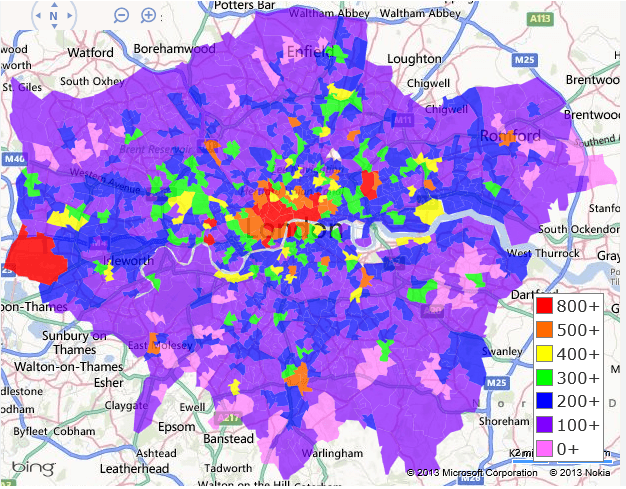
If you are deciding what level of security your London property needs, the first thing worth doing is looking at your borough's crime data. The Metropolitan Police publishes recorded crime statistics broken down by area, and the variation across Greater London is substantial. A business in Westminster faces a very different risk profile from one in Bexley, and a one-size-fits-all approach to security is rarely the most cost-effective one.
This guide uses publicly available Metropolitan Police data to give you a practical sense of the crime landscape across Greater London, and explains what the numbers should mean for your security decisions — whether you are a business owner, facilities manager, or homeowner.
Greater London records more crime per capita than any other police force area in England and Wales. The Metropolitan Police records roughly 800,000 to 900,000 crimes per year across the 32 boroughs and the City of London. That figure covers everything from low-level antisocial behaviour to serious violence, so the raw number needs context.
For businesses and homeowners, the categories that most directly drive security investment decisions are:
Central London boroughs consistently report the highest volumes of recorded crime, largely because of the concentration of commercial activity, tourist footfall, and nighttime economy venues. Westminster and Southwark regularly sit at the top of the per-capita crime rankings, followed by Camden, Lambeth, and Tower Hamlets.
For businesses in these areas, the risk is not theoretical. Westminster alone accounts for a significant share of all theft offences recorded across London, driven by the density of retail and hospitality premises. Southwark and Lambeth see elevated rates of commercial burglary as well as vehicle crime, reflecting the mix of warehouse, industrial, and commercial premises in those boroughs.
Inner East London boroughs — Hackney, Newham, Tower Hamlets — have seen sustained pressure on burglary and robbery statistics in recent years. These boroughs also include significant concentrations of small and medium businesses in manufacturing, logistics, and hospitality, sectors where physical security is often underinvested relative to the risk.
Outer London boroughs — Bexley, Kingston upon Thames, Sutton, Richmond — report lower crime rates in most categories. But lower does not mean absent. Commercial burglary in outer London boroughs often targets premises precisely because security is perceived as lighter.
The practical implication of London's crime distribution is that your security investment should be proportionate to your specific risk, informed by your borough's profile and the nature of your premises.
A few consistent patterns emerge from the data:
High-footfall commercial premises in central London face the highest rate of opportunistic theft and antisocial behaviour. CCTV coverage is essential, both as a deterrent and for evidence in prosecution. Retail businesses in Westminster, Camden, and Southwark typically need comprehensive internal and external camera coverage, combined with a monitored intruder alarm for out-of-hours protection.
Offices and professional services premises in inner London boroughs face a different risk profile: after-hours intrusion, tailgating into secure areas, and internal theft. Access control — controlling who can enter which area and when — is often the highest-return security investment for this type of premises. Paxton networked access control allows facilities managers to see a complete audit trail of who accessed which door, providing both a deterrent and an investigation tool.
Industrial, warehouse, and logistics premises in areas like Newham, Barking and Dagenham, and Enfield face elevated rates of vehicle crime and perimeter intrusion. CCTV coverage needs to extend beyond the building itself to car parks, loading areas, and perimeter fencing. External PTZ cameras with wide-area coverage and good low-light performance are the appropriate technology for these environments.
Hospitality and late-night venues across Southwark, Lambeth, Westminster, and Hackney face the highest rates of violence and public order incidents. Entry management — video door entry, queue management with camera monitoring, and access control for staff-only areas — is a higher priority than it would be for a standard office or retail environment.
Research consistently shows that visible CCTV acts as a deterrent to opportunistic crime. A well-designed CCTV system — with cameras positioned to cover entry points, car parks, and internal high-value areas — does three things: it reduces the likelihood of an incident happening in the first place, it provides evidence when incidents do occur, and it speeds up police investigation and prosecution.
For London businesses, the practical requirement is that cameras cover the right areas, produce footage of usable quality, and retain recordings for a sufficient period. Modern IP cameras from manufacturers such as Hanwha and Axis deliver 4K resolution with strong low-light performance, meaning that facial recognition from footage is realistic rather than aspirational. Storage should be sized for a minimum of 30 days' continuous recording for commercial premises.
A CCTV system records what happens. An intruder alarm system responds to it. For commercial properties in medium-to-high crime boroughs, a professionally monitored intruder alarm — one connected to an alarm receiving centre that can alert keyholders and dispatch a response — is not optional.
Insurance requirements for London commercial properties frequently specify a graded intruder alarm system meeting BS EN 50131. Grade 2 covers the majority of commercial premises; Grade 3 is specified for higher-value targets such as jewellers, pharmacies, and data centres.
Ajax wireless alarm systems, which we install as certified Ajax engineers, communicate via Ethernet, mobile data, and Wi-Fi simultaneously — meaning they remain operational even if a burglar cuts a phone line or disrupts a single communication path.
For multi-occupancy buildings, managed office environments, and any premises where restricting access to sensitive areas matters, access control is the security layer that is most often underinvested in London commercial properties.
The value is not just in preventing unauthorised entry. It is in the audit trail: a complete timestamped record of who entered which area, when, using which credential. In the event of a theft, a data breach, or an HR investigation, that record is often the most valuable piece of evidence available.
Paxton Net2 and Paxton10 — the platforms we are certified to install and maintain — scale from a single door to hundreds of readers across multiple sites. The cloud-based Paxton10 platform is particularly well suited to London businesses with multiple offices who want to manage access across all their sites from a single interface.
The right security system for a business on Oxford Street is not the same as the right system for a professional services firm in Richmond. The right system for a hotel in Westminster is not the same as the one for a logistics warehouse in Newham.
Slam Systems designs security systems based on your actual risk profile: your borough's crime data, the nature of your premises, your hours of operation, and your budget. We do not sell packages. We survey your site, assess your specific risks, and specify what you actually need.
All our installations are carried out by our own in-house engineers — no subcontractors — and include a free site survey as standard. We cover all London boroughs and the surrounding counties of Surrey, Kent, Buckinghamshire, and Middlesex.
If you are reviewing your security in light of your local crime data, or if you simply want an independent assessment of what your premises actually needs, get in touch.